


AR-15 BCG Guide: Coatings, HPT/MPI & How to Choose
Posted by Kevin on
AR-15 Bolt Carrier Group Guide: Coatings, Mil-Spec Features and How to Choose
Quick answer: For most AR-15 builds, the best bolt carrier group (BCG) is a full-auto (M16) profile carrier with a staked gas key and an MPI-tested bolt made from Carpenter 158 or 9310 steel. The coating matters less than those basics. Black nitride is the best all-around value, nickel boron is the easiest to clean, and phosphate is the traditional mil-spec finish. Buy a lightweight BCG only if you also run an adjustable gas block.
The BCG is the heart of the AR-15: it feeds, fires, extracts and ejects every round. This guide explains what is inside a BCG, what the specs on a product page actually mean, how the common coatings compare, and which BCG fits your caliber. Every BCG mentioned here is stocked in our AR-15 bolt carrier group collection.
What is in an AR-15 bolt carrier group?
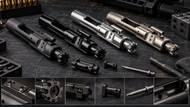
A complete BCG is a small assembly of parts that work together each time the rifle cycles:
- Bolt carrier: the main body that rides in the upper receiver and carries everything else.
- Gas key: bolted to the top of the carrier, it receives gas from the gas tube to drive the carrier rearward.
- Bolt: locks into the barrel extension, holds the cartridge and absorbs the pressure of firing.
- Extractor and ejector: pull the spent case from the chamber and kick it out of the ejection port.
- Cam pin: rotates the bolt to lock and unlock it.
- Firing pin and retaining pin: strike the primer and hold the pin in place.
- Gas rings: seal gas behind the bolt so the carrier moves reliably.
Most of these are replaceable wear parts. Extractors, gas rings and cam pins are sold separately in our BCG small parts category, including the enhanced one-piece gas ring and the black nitride cam pin.
What do mil-spec BCG features actually mean?
Product listings use shorthand. Here is what to look for and why it matters:
| Spec | What it means | Why it matters |
|---|---|---|
| Carpenter 158 or 9310 bolt steel | The alloy the bolt is machined from | Both are proven, high-strength steels. 158 is the original mil-spec choice; 9310 is a common, durable alternative. |
| MPI (magnetic particle inspected) | The bolt is magnetically tested for hidden cracks | Catches flaws before the bolt is sold. Look for it on any BCG you plan to rely on. |
| HPT (high pressure tested) | The bolt is proof-fired with an overpressure round, then inspected | Confirms the bolt survives stress beyond normal loads. HPT/MPI together is the gold standard. |
| Staked gas key | Metal around the gas key screws is punched so they cannot back out | A loose gas key causes short-stroking and malfunctions. Proper staking prevents it. |
| Full-auto (M16) profile | A heavier carrier with a full-length rear section | Adds mass for smoother, more reliable cycling. Legal in semi-auto rifles and the most common choice. |
| Semi-auto (AR-15) profile | A lighter carrier with material cut from the rear | Lighter, but less forgiving. Most shooters choose the M16 profile instead. |
For example, the AO Precision premium nitride BCG and the Spike's Tactical HPT/MPI bolt carrier group both list HPT/MPI bolts and M16-profile carriers.
Which BCG coating is best: nitride, nickel boron, phosphate or titanium nitride?
Coatings change how a BCG resists wear and corrosion and how easily it cleans. None of them makes up for a poor bolt or an unstaked gas key, so check the basics first.
Black nitride
Nitriding hardens the steel surface instead of adding a layer on top, so it does not chip or flake. It resists corrosion, runs slick and costs little extra. That combination makes it the best value for most shooters. Options include the Premiere AR-15 bolt carrier group in black nitride.
Nickel boron (NiB)
Nickel boron is a silver, very slick coating that sheds carbon easily, so it is the fastest to clean. It costs more than nitride. Popular choices include the Spike's Tactical nickel boron BCG, the WMD Guns NiB-X full mass BCG and the Premiere nickel boron and black nitride BCG. See all nickel boron and nickel Teflon AR parts.
Phosphate (Parkerized)
Phosphate is the traditional mil-spec finish, usually paired with a chrome-lined carrier interior and gas key. It holds oil well and is proven, but it is less corrosion resistant and harder to clean than nitride or nickel boron.
Titanium nitride (TiN)
Titanium nitride is a very hard ceramic coating, often gold, that is slick and easy to wipe clean. It is popular for its look and low friction, as on the Premiere titanium nitride BCG in gold.
| Coating | Corrosion resistance | Ease of cleaning | Cost | Best for |
|---|---|---|---|---|
| Black nitride | High | Good | Low | Best overall value |
| Nickel boron | High | Excellent | Medium | Shooters who hate cleaning |
| Phosphate | Moderate | Fair | Low | Traditional mil-spec builds |
| Titanium nitride | High | Excellent | Medium | Low friction and a custom look |
Do you need a lightweight or low-mass BCG?
A lightweight AR-15 BCG reduces reciprocating mass, which can lower felt recoil and muzzle movement. It is popular in competition rifles. The trade-off is reliability: a lighter carrier has less momentum to overcome dirt, weak ammo or a heavily gassed system.
Run a lightweight BCG only if you also install an adjustable gas block, such as the RTB adjustable gas block, so you can tune the gas to the lighter carrier. An adjustable gas key is another way to tune gas at the carrier itself. For a general-purpose rifle, stick with a full-mass M16 BCG.
Which BCG fits your caliber?
The bolt face has to match the cartridge, so caliber decides which BCG you can use:
- 5.56 NATO, .223 Rem, .223 Wylde and 300 Blackout all use a standard AR-15 BCG. Shop 5.56 / .223 / 300 BLK bolt carrier groups.
- 6.5 Grendel, 6.8 SPC / .224 Valkyrie, 7.62x39 and .458 SOCOM need caliber-specific bolts with a different bolt face. See 6.5 Grendel BCGs, 6.8 SPC / .224 Valkyrie BCGs, 7.62x39 BCGs and .458 SOCOM BCGs.
- 9mm AR builds use a heavier, blowback-operated bolt. See 9mm BCGs.
- .22LR uses a dedicated rimfire bolt or drop-in conversion. See .22LR BCGs and conversion kits and our AR-15 .22LR conversion guide.
- AR-10 / .308 rifles use a larger BCG that will not fit an AR-15. See AR-10 / .308 bolt carrier groups.
Left-handed shooters with a left-side ejection upper need a matching carrier, such as the left-handed black nitride BCG.
Do you need to check headspace with a new BCG?
Yes, whenever you pair a new bolt with a barrel. Headspace is the distance between the bolt face and the point in the chamber where the cartridge stops. If it is out of spec, the rifle can fail to fire or, in rare cases, become unsafe. A gunsmith or an armorer with headspace gauges can check it quickly.
Complete uppers ship with the bolt and barrel already matched. If you are building from parts, a 16" M4 barrel and nitride BCG combo is an easy way to start with matching components. You should still have headspace checked before firing.
How to keep your BCG running
- Run it wet. The AR-15 runs best with the carrier, bolt and cam pin well lubricated.
- Clean carbon from the bolt tail and carrier interior on a regular schedule.
- Check the gas rings. If the bolt collapses into the carrier under its own weight when stood on its face, replace the rings.
- Watch the extractor. Repeated failures to extract usually mean a worn extractor or spring. Replacement extractors and bolt completion kits are inexpensive.
- Inspect the bolt lugs and cam pin hole for cracks during deep cleaning, especially on high-round-count rifles.
For lube, brushes and scrapers, see our gun cleaning supplies.
AR-15 Bolt Carrier Group FAQ
What is the best BCG coating for an AR-15?
Black nitride is the best value for most shooters because it is hard, corrosion resistant and inexpensive. Nickel boron and titanium nitride are easier to clean but cost more. Phosphate is the traditional mil-spec finish.
Is a full-auto (M16) BCG legal in a semi-auto AR-15?
Yes. An M16-profile bolt carrier group is legal to own and use in a semi-automatic AR-15. The term refers to the carrier's shape and weight, and it does not make a rifle fully automatic.
What does HPT/MPI mean on a bolt carrier group?
HPT means the bolt was high pressure tested with an overpressure proof round. MPI means it was magnetic particle inspected for hidden cracks. Together they confirm the bolt is sound before you fire it.
Can I use a 5.56 BCG for 300 Blackout?
Yes. 300 Blackout uses the same bolt face as 5.56 NATO and .223 Remington, so a standard AR-15 BCG works. Calibers such as 6.5 Grendel, 7.62x39 and .458 SOCOM need caliber-specific bolts.
Should I buy a lightweight BCG?
Only if you also run an adjustable gas block or adjustable gas key so you can tune the gas system. A lightweight BCG reduces recoil but is less reliable in a standard, over-gassed rifle.
Do I need to check headspace when I replace my BCG?
Yes. Any time you pair a new bolt with a barrel, have headspace checked with proper gauges before firing. Complete uppers ship with the bolt and barrel already matched.
How often should I replace my BCG parts?
Replace gas rings when the bolt no longer holds its own weight in the carrier, and replace the extractor or its spring if you see repeated failures to extract. Inspect the bolt for cracks during deep cleaning, especially on high-round-count rifles.
Find the right BCG for your build
For most rifles, start with an HPT/MPI, M16-profile BCG in black nitride or nickel boron. Shop all AR-15 bolt carrier groups, or pair your BCG with a matching AR-15 charging handle. Not sure which BCG fits your upper? Contact our team before you order.