


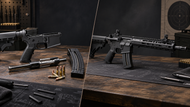
AR-15 .22LR Conversion: Drop-In Kit vs. Dedicated Upper
Posted by Kevin on
AR-15 .22LR Conversion Guide: Drop-In Kit vs. Dedicated .22 Upper
Quick answer: An AR-15 .22LR conversion lets you shoot cheap .22 Long Rifle ammo from the rifle you already own. You have two routes. A drop-in conversion kit replaces your bolt carrier group and uses your existing 5.56 barrel, so it is the cheapest way in. A dedicated .22LR upper pairs a barrel chambered in .22LR with a matching bolt group, so it is more accurate and swaps onto your lower in seconds. If you plan to shoot .22 regularly, a dedicated upper is the better long-term buy.
This guide explains how each setup works, what parts you need, which magazines and ammo run best, and how to keep a rimfire AR reliable. Right To Bear designs its own .22LR AR parts and accessories, built to work with CMMG-pattern rimfire components, so every part mentioned here is something we stock and support.
Why convert an AR-15 to .22LR?
A .22LR setup keeps the same controls, trigger, stock and optic you already train with, while cutting the cost of every range trip. That makes it useful for:
- Cheap practice. .22LR typically costs a fraction of 5.56 per round, so you can run more drills for the same budget.
- Training new shooters. Low recoil and low noise make it easier to teach fundamentals on a full-size AR.
- Indoor and short ranges. Many ranges that restrict centerfire rifles allow rimfire.
- Plinking and small game. A rimfire AR is quiet, light on the shoulder and fun to shoot all day.
- Suppressor host. .22LR is one of the quietest calibers to shoot suppressed.
Because the lower receiver stays the same, you keep your trigger feel and muscle memory, which matters more for practice than any other rimfire rifle can offer.
How a drop-in .22LR conversion kit works
A drop-in kit is a blowback .22LR bolt group shaped like an AR-15 bolt carrier. It comes with a chamber adapter, a sleeve that sits inside your 5.56 chamber so the .22 cartridge headspaces correctly. You pull your standard bolt carrier group, slide the .22 bolt in, load a .22LR magazine and shoot. No tools and no permanent changes. Drop-in kits and replacement .22LR chamber adapters are listed with our .22LR BCGs and conversion kits.
Pros
- Lowest cost way to shoot .22 from your AR
- Swaps in and out in a minute or two
- Uses your existing upper, barrel, handguard and optic
Cons
- Reduced accuracy. A 5.56 barrel has a slightly larger bore and a much faster twist than .22LR bullets are designed for, and the bullet has to jump from the adapter into the rifling. Expect plinking accuracy, not precision.
- Fouling in your 5.56 barrel. Lead and carbon from rimfire ammo build up in the chamber area and bore, so you need to clean thoroughly before you go back to 5.56.
- Point of impact shift. Your zero will usually move when you switch calibers.
Safety note: always remove the chamber adapter before you reinstall your 5.56 bolt carrier group. A forgotten adapter left in the chamber is a serious hazard. Make checking the chamber part of every swap.
How a dedicated .22LR upper works
A dedicated setup uses a barrel chambered in .22LR, typically with a slow twist rate suited to rimfire bullets, and a dedicated .22 bolt group with no chamber adapter. Install it in a standard AR-15 upper receiver and you have a second upper that pins onto the same lower. Push two pins, swap uppers, and you are shooting .22.
Pros
- Better accuracy from a barrel built for the .22LR bullet
- No fouling in your 5.56 barrel, because it never sees rimfire ammo
- Keep a separate optic zeroed for .22 on the dedicated upper
- Swaps faster than a drop-in kit: no adapter to remember
Cons
- Higher upfront cost than a bolt-only kit
- A second upper to store and maintain
The easiest route is a complete .22LR upper group that ships ready to install. For a rifle, start with a 16" option such as the RTB complete 16" .22LR lightweight upper with bolt group and charging handle. Building an AR pistol instead? The 4.5" .22LR upper receiver build kit includes the barrel, rail, muzzle device, bolt group and charging handle (read the legal section before pairing a short upper with any lower).
Drop-in kit vs. dedicated upper: side-by-side
| Factor | Drop-in conversion kit | Dedicated .22LR upper |
|---|---|---|
| What you buy | .22 bolt group, chamber adapter, magazines | .22LR barrel, dedicated bolt group, upper receiver, handguard, magazines |
| Barrel used | Your existing 5.56 barrel | Barrel chambered in .22LR |
| Accuracy | Plinking grade | Noticeably tighter groups |
| Upfront cost | Lowest | Higher |
| Swap time | A minute or two (BCG and adapter) | Seconds (push two pins) |
| Rimfire fouling in 5.56 barrel | Yes, clean before switching back | None |
| Optic zero | Shifts between calibers | Separate optic can stay zeroed |
| Best for | Occasional .22 practice on a budget | Regular training, new shooters, suppressed shooting |
Parts list for a dedicated AR-22 build
If you are building a dedicated .22LR upper from parts, here is what you need. Your lower receiver, trigger and stock stay the same.
- .22LR barrel. Choose length by use. A 16" barrel suits a rifle build, while short barrels suit pistol builds (see the legal section below). Browse .22LR AR-15 barrels, including the RTB 16" M4 profile .22LR barrel and the RTB 4.5" medium taper .22LR barrel. Our AR barrel buying guide covers length and profile in more detail.
- Dedicated .22LR bolt group. The RTB dedicated .22LR stainless steel bolt group is designed to work with all CMMG and RTB .22LR barrels. See all .22LR bolt carrier groups.
- Upper receiver. Any standard AR-15 upper works. Because a blowback .22 does not need a forward assist, a slick side upper is a clean, lightweight choice, such as the RTB 9mm / .22LR slick side upper receiver.
- Charging handle. A .22-specific charging handle matches the shorter bolt group. Options include the RTB polymer .22LR charging handle and the RTB ambidextrous .22LR charging handle.
- Handguard and muzzle device. Rimfire uppers have no gas system, so you have more freedom with handguard length and mounting.
- .22LR magazines. See the next section.
Building a pistol and want the barrel, bolt and charging handle matched for you? The RTB dedicated .22LR kit with 4.5" barrel bundles all three, so you only need an upper receiver and handguard.
Magazines and ammo that run reliably
Magazines
.22LR conversion magazines are shaped to fit your AR-15 magazine well and release like a standard mag. Use magazines designed for CMMG-pattern .22 bolts, such as the RTB 10-round .22LR AR magazine. Browse all .22LR AR magazines for 10- and 25-round options.
Most rimfire AR setups do not lock the bolt open after the last round, so check the chamber visually when you finish a string.
Ammo
Blowback .22 bolts cycle most reliably with high-velocity, round-nose ammunition in the 36 to 40 grain range. Low-power target loads and some bulk ammo may not cycle consistently. Buy a few different brands, run a box of each, and stick with what your setup likes.
Cleaning and maintenance
Rimfire ammunition is dirtier than centerfire, and a .22 bolt group collects carbon and wax quickly. A few habits keep it running:
- Clean the bolt face, extractor and chamber every few hundred rounds, or whenever you see failures to extract.
- Lubricate lightly. Heavy oil attracts fouling in a rimfire action.
- Keep spares. Extractors and firing pins are the most common wear items. Stock a .22LR bolt extractor replacement kit and a .22LR firing pin replacement kit.
- Tune reliability. The Bore Buddy .22LR AR reliability kit is a popular upgrade if you see light strikes or extraction issues.
- Watch your hammer spring. Very light aftermarket hammer springs can cause light primer strikes on rimfire. If you run a reduced-power AR trigger, test it with your .22 upper before relying on it.
For brushes, solvent and lube, see our gun cleaning supplies.
Pistol uppers, suppressors and the law
A .22LR conversion does not change the legal status of your lower receiver, but barrel length and accessories can:
- Short barrels. Putting an upper with a barrel under 16" on a lower that has a stock creates a short-barreled rifle, which is regulated under the National Firearms Act. Short .22LR pistol and SBR barrels belong on a lower configured as a pistol, or on a registered SBR.
- Suppressors. .22LR pairs well with a rimfire suppressor such as the CMMG ZEROED 22 rimfire suppressor, but suppressors still require NFA approval and are restricted in some states.
- State and local rules. Magazine capacity, feature and shipping rules vary. Check our shipping restrictions and current state law before you order.
Upper receivers, barrels and bolt groups are parts, not firearms, under federal law, so they ship directly to you in most states. Items that do require a transfer are covered in our firearm and lower receiver purchasing guidelines.
AR-15 .22LR Conversion FAQ
Can you shoot .22LR out of an AR-15?
Yes. A standard AR-15 lower can fire .22 Long Rifle once you install either a drop-in .22LR conversion kit or a dedicated .22LR upper. You cannot fire .22LR through a standard 5.56 bolt carrier group.
What is the difference between a .22LR conversion kit and a dedicated .22LR upper?
A drop-in conversion kit replaces only your bolt carrier group and uses a chamber adapter in your existing 5.56 barrel. A dedicated .22LR upper has its own barrel chambered in .22LR and its own bolt group, so it is more accurate and keeps rimfire fouling out of your 5.56 barrel.
Is an AR-15 .22LR conversion kit accurate?
A drop-in kit is accurate enough for plinking and close-range practice, but a 5.56 barrel is not built for .22LR bullets. A dedicated .22LR barrel produces noticeably tighter groups.
Will shooting .22LR damage my 5.56 barrel?
No, but rimfire ammo leaves lead and carbon in the chamber area and bore, so clean thoroughly before shooting 5.56 again. Always remove the chamber adapter before reinstalling your 5.56 bolt carrier group. A dedicated .22 upper avoids the issue entirely.
Do I need to change my lower receiver or trigger to shoot .22LR?
No. Your lower receiver, trigger, grip and stock stay the same. The only exception is a very light aftermarket hammer spring, which can cause light primer strikes with rimfire ammo.
Do I need special magazines for a .22LR AR-15?
Yes. .22LR rounds are too short to feed reliably from 5.56 magazines. Use .22LR AR magazines that fit the AR-15 magazine well and match your bolt group.
What ammo works best in a .22LR AR-15?
High-velocity, round-nose .22LR in the 36 to 40 grain range cycles most reliably in blowback .22 bolts. Low-power target loads may not cycle consistently, so test a few brands and stick with what your setup runs best.
Are Right To Bear .22LR parts compatible with CMMG?
Yes. Right To Bear .22LR barrels, bolt groups and magazines are designed to work with CMMG .22 conversion components, so you can mix them in one build.
Can I put a short .22LR pistol upper on my AR-15 rifle lower?
Not legally without registration. Installing an upper with a barrel under 16 inches on a lower with a stock creates a short-barreled rifle under the National Firearms Act. Short .22LR uppers belong on a lower configured as a pistol or on a registered SBR. Check federal and state law before you build.
Can I convert a Glock to .22LR too?
Yes. Slide-based conversion kits are available for popular Glock models, such as the .22LR conversion kit for Glock 19 / 23 Gen 5.
Ready to start shooting .22 from your AR?
For occasional practice, a drop-in kit gets you shooting for the least money. For regular training, cleaner 5.56 barrels and better groups, go with a dedicated upper. Shop the full .22LR AR parts collection or see everything in the Right To Bear product line. Questions about compatibility? Contact our team before you order.