


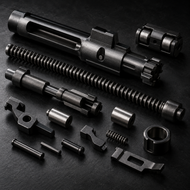
AR-15 Build Kit Guide: Every Part You Need and the Best Kit for Your First Build
Posted by Kevin on
AR-15 Build Kit Guide: Every Part You Need and the Best Kit for Your First Build
Quick answer: An AR-15 build kit groups the parts you need to assemble a rifle or pistol at home. The easiest route for a first build is a complete upper paired with a lower build kit, then a stripped lower receiver purchased through an FFL. That split matters because the lower receiver is the only part that counts as a firearm under federal law. Everything else, including the barrel, bolt carrier group and upper receiver, ships directly to you in most states.
This guide lists every part an AR-15 needs, explains the different kinds of build kits, and helps you choose a caliber and barrel length that fit how you will use the rifle. You will find every kit mentioned here in our AR-15 build kits collection.
The two halves of an AR-15
Every AR-15 is made of an upper and a lower that join with two pins. Understanding which parts belong to each half makes shopping much simpler.
The upper
- Upper receiver with forward assist and dust cover (or a slick side receiver)
- Barrel with barrel nut
- Gas block and gas tube
- Handguard
- Muzzle device
- Bolt carrier group (BCG)
- Charging handle
The lower
- Lower receiver (the serialized, regulated part)
- Lower parts kit: trigger group, safety, bolt catch, magazine catch, pins, springs and grip
- Buffer tube, castle nut, end plate, buffer and buffer spring
- Stock or pistol brace
You will also need sights or an optic and at least one magazine before the rifle is ready for the range.
Types of AR-15 build kits
Complete rifle and pistol build kits
A complete build kit bundles upper and lower parts in one order, so you only add the lower receiver. These are the simplest option for a first build. See our rifle and pistol build kits, and budget-focused options such as the $315 rifle build kit and the $400 two-piece AR build kit. Check each listing to see exactly what is included.
Lower build kits
A lower build kit includes the lower parts kit, buffer tube assembly and stock or brace. Pair it with a complete upper and a stripped lower and you have a full rifle. Our lower parts kit vs. lower build kit guide explains the difference in detail.
Upper build kits
Upper build kits include the parts to assemble an upper yourself, usually the barrel, handguard, gas system and muzzle device. Some include the upper receiver, BCG and charging handle, and some do not. Want to choose every component? Use our build your own upper tool.
Complete uppers
A complete upper arrives fully assembled. Many include a BCG and charging handle, but some are sold without them, such as the RTB 16" 5.56 upper receiver without BCG and charging handle. If yours is listed "without BCG and CH," add a 5.56 bolt carrier group and an AR-15 charging handle.
Build kit vs. complete upper and lower build kit vs. buying parts
| Approach | Difficulty | Tools needed | Customization | Best for |
|---|---|---|---|---|
| Complete upper + lower build kit | Easiest | Basic lower tools only | Moderate | First-time builders |
| Complete rifle or pistol build kit | Easy to moderate | Depends on whether the upper is assembled | Moderate | Budget builds and one-order shopping |
| Upper build kit + lower build kit | Moderate | Upper and lower tools, plus a headspace check | High | Builders who want to assemble the upper too |
| Individual parts | Advanced | Full armorer's tool set and headspace gauges | Total | Experienced builders |
How to choose a caliber and barrel length
Decide what the rifle is for before you buy a kit. Caliber and barrel length shape everything else.
- 5.56 NATO / .223 Wylde: the most versatile choice for general purpose, training and home defense. Ammo and magazines are everywhere. See 5.56 / .223 barrels.
- 300 Blackout: excellent for short barrels and suppressed shooting, and it uses standard AR-15 magazines and bolts. See 300 Blackout barrels.
- 9mm: low recoil and shares ammo with your handgun, but needs a dedicated 9mm bolt, magazines and often a 9mm-specific lower. See 9mm AR parts.
- .22LR: the cheapest to shoot and great for training. See our AR-15 .22LR conversion guide or a ready-made .22LR rifle build kit.
For barrel length, a 16" barrel is the standard rifle choice and the legal minimum for a rifle without NFA registration. Shorter barrels belong on AR pistols or registered short-barreled rifles. Our AR barrel buying guide covers length, profile and twist rate.
AR-15 build checklist
Use this list to make sure nothing is missing before build day:
- Lower receiver purchased through an FFL. See stripped AR-15 lower receivers.
- Lower parts kit from our AR-15 lower parts kits, or a full lower build kit.
- Buffer tube kit and stock, if not already in your lower build kit. See the stock and buffer tube kit combo.
- Complete upper or upper build kit.
- Bolt carrier group and charging handle, if your upper does not include them. Our AR-15 bolt carrier group guide explains how to choose one.
- Sights or optic. See red dot sights and iron sights.
- Magazines for your caliber, such as 5.56 / .223 / 300 BLK magazines.
- Sling and cleaning gear. See AR-15 slings and gun cleaning supplies.
Tools you need for an AR-15 build
Pairing a complete upper with a lower build kit keeps your tool list short. Assembling the upper yourself adds more.
- For the lower: roll pin punches, a nylon or brass hammer, a lower receiver vise block and an armorer's wrench.
- For the upper: an upper receiver vise block, a torque wrench, the correct barrel nut wrench and headspace gauges.
- Always useful: gun grease, thread locker, painter's tape and a clean, well-lit bench.
Find them in our AR-15 tools section.
Safety note: if you install your own barrel or pair a new bolt with a barrel, have headspace checked with proper gauges before you fire. If you are not confident in any step, have a qualified gunsmith inspect the finished rifle.
Legal considerations before you build
- The lower receiver is the firearm. It must be purchased through a licensed dealer. Our firearm and lower receiver purchasing guidelines explain the process.
- Barrel length. A rifle with a stock needs a barrel of at least 16 inches, or an overall barrel length that reaches 16 inches with a permanently attached muzzle device. Anything shorter on a stocked lower is a short-barreled rifle regulated under the NFA.
- State laws. Some states restrict features, magazine capacity or specific parts. Our featureless AR-15 parts help builders in restricted states, and our shipping restrictions page lists what we cannot ship to your area.
AR-15 Build Kit FAQ
What is included in an AR-15 build kit?
It depends on the kit. A complete build kit usually includes the upper parts or a complete upper, the lower parts kit, the buffer tube assembly and a stock. Build kits do not include the lower receiver, which is purchased separately through an FFL.
Do I need an FFL to buy an AR-15 build kit?
Not for the kit itself in most states. Uppers, barrels, BCGs and lower parts are not firearms under federal law. The lower receiver is a firearm and must be transferred through a licensed dealer.
Is it cheaper to build an AR-15 than to buy one?
It can be, especially with a budget build kit. The bigger advantage is choosing every part yourself, so you pay only for the features you want and can upgrade one part at a time later.
What is the easiest way to build an AR-15 for the first time?
Buy a complete upper and a lower build kit, then install the lower parts into a stripped lower receiver. The upper arrives assembled and matched, so the only assembly is the lower.
What tools do I need to build an AR-15?
For a lower build, you need roll pin punches, a small hammer, a lower vise block and an armorer's wrench. Assembling an upper also requires an upper vise block, a torque wrench and headspace gauges.
What caliber should my first AR-15 build be?
5.56 NATO or .223 Wylde is the best first choice. Ammo, magazines and parts are widely available, and it covers training, target shooting and home defense.
Can I build an AR pistol with a build kit?
Yes. Pistol build kits use a pistol buffer tube and often a pistol brace instead of a stock. Do not install a stock on a lower with a barrel under 16 inches unless the rifle is registered as an SBR, and check current federal and state law before you build.
Start your AR-15 build
Browse all AR-15 build kits, pick up a complete upper and a lower build kit, or design your own with builder sets. Not sure which kit fits your plans? Contact our team before you order.